Post-Traumatic Stress Disorder (PTSD) Treatment in Glenview
A non-invasive, drug-free approach to supporting brain recovery
A New FDA-Cleared Option for PTSD
The MeRT® system is now FDA-cleared for the personalized treatment of post-traumatic stress disorder (PTSD).
Instead of a standard protocol applied to everyone, MeRT is non-invasive and fully individualized: it begins with an EEG assessment of your unique brain activity, which then informs a transcranial magnetic stimulation (TMS) protocol shaped around your specific patterns.
MeRT combines EEG-based analysis with personalized TMS treatment parameters, bringing a new, individualized approach to PTSD care.
The Clinical Trial by the Numbers
52%
Average Reduction in PTSD Symptoms
Participants experienced an average 52% reduction in PTSD symptom severity in the FDA-cleared clinical trial.
68%
No Longer Met the Clinical Threshold for PTSD
More than two-thirds of the participants no longer met the clinical criteria for PTSD following MeRT treatment.
Clinically Significant Results
Meaningful Improvement
Participants experienced improvements that exceeded the benchmark for clinically meaningful change. This means that the participants experienced noticeable changes following MeRT treatment.
Objective
Improvement
Measurable Brain Changes
Symptom improvement was accompanied by more normal patterns of brain function.
Benefits Continued Over Time
Lasting Results
Participants maintained and continued to improve their results during the six-month follow-up period following the start of treatment.
Results are from the FDA-cleared clinical trial evaluating the MeRT® System for the treatment of PTSD. Individual results may vary. MeRT® is FDA-cleared for the treatment of adults with PTSD.
When Trauma Changes the Brain
If you have Post-Traumatic Stress Disorder (PTSD), you know how persistent and disruptive symptoms can be. While some people recover over time, many continue to experience symptoms for years—sometimes with flare-ups triggered long after the original trauma.
If you’ve tried multiple approaches and still feel stuck, it’s understandable to feel overwhelmed. PTSD symptoms may lessen for a period of time, only to resurface under stress.
That’s where advanced neuromodulation approaches may help.
At Brain Treatment Center Glenview, we offer advanced, individualized neuromodulation approaches, including EEG-guided therapies, designed to support healthier brain function without drugs or surgery.
It was absolutely terrifying not to know what was wrong with me or how to fix the problem. The Brain Treatment Center not only identified the deteriorated state of my brainwave activity, they restored its function.”
– US Army Veteran


How PTSD Can Show Up
PTSD can affect people differently, but common symptoms include:
- Sleep disruption (insomnia, nightmares)
- Anxiety, panic, or constant alertness
- Mood changes, including depression or irritability
- Difficulty concentrating or remembering
- Emotional numbness or withdrawal
- Strong reactions to reminders or triggers
- Relationship or work difficulties
Understanding rTMS and MeRT for PTSD
Repetitive Transcranial Magnetic Stimulation (rTMS) is a non-invasive neuromodulation technique that uses magnetic pulses to stimulate targeted brain regions. rTMS devices are FDA-approved for Major Depressive Disorder and OCD and have been studied extensively for their effects on brain network regulation.
MeRT (Magnetic e-Resonance Therapy) builds on the same rTMS technology but adds a layer of personalization.
Rather than using a one-size-fits-all stimulation protocol, MeRT incorporates advanced diagnostic testing, including quantitative EEG (qEEG), to evaluate each person’s brainwave patterns. These findings are then used to guide stimulation parameters such as location, frequency, and intensity.
In short:
- rTMS provides the FDA-cleared neuromodulation foundation
- MeRT is a customized, EEG-guided application of that technology, now FDA-cleared as an adjunctive treatment for PTSD
As of June 2026, MeRT holds FDA 510(k) clearance as an adjunctive treatment for PTSD, meaning it’s intended to be used alongside your other PTSD care. For conditions other than PTSD, MeRT remains an individualized, off-label approach evaluated on a case-by-case basis.

How EEG-Guided Neuromodulation May Help PTSD Symptoms
Research shows that PTSD is often associated with disruptions in brain network communication, particularly in regions involved in fear response, emotional regulation, and stress processing.
Through qEEG brain mapping, we can identify areas of dysregulation and asymmetry in brainwave activity. These findings help inform whether an individualized neuromodulation approach may be appropriate.
Using rTMS technology guided by this data, MeRT® aims to:
- Support healthier communication between brain regions
- Reduce patterns associated with hyperarousal and emotional reactivity
- Promote improved regulation of mood and stress responses
Many patients report meaningful improvement in symptoms such as anxiety, sleep disruption, irritability, and emotional numbness. Individual results vary.
“It’s tapping into our natural biological mechanism.”
Functionally, we’re reminding the brain where it wants to be, where it’s most comfortable. It’s tapping into our natural biological mechanism.
“Mother Nature engineered us as healing organisms, whether it’s putting two ends of a broken bone together, allowing it to heal, or two ends of a wound together. In this case, sometimes our brain will get stuck in a frequency that it’s not comfortable at, for whatever reason. And we’re just giving it that friendly reminder to go back and giving it that stimulation where it can move back.
“We’re not trying to overpower the brain with really high-power stimuli. It’s more of just a gentle reminder of where the brain needs to go and then the body does a lot of the work for us.”
– Dr. Erik Won, President and Chief Medical Officer of Wave Neuroscience


Contact our New Patient Coordinator
Or fill in the form at the bottom of the page for more information or to book an initial consultation.
What to Expect: The Steps of MeRT Treatment for PTSD
MeRT is a relatively new treatment, and you may have many questions about whether it’s right for your PTSD symptoms. We understand — and that’s why your first step is a simple phone consultation with our New Patient Coordinator. during this free consultation, you can discuss your symptoms and history, including any treatments you have already tried or that are ongoing. You can ask all the questions you want, and she will explain our protocols, fees, and treatment details.
Initial Testing and Consultation
If, after your phone consultation, you want to take the next step, we can set up two appointments, one for testing and one for a doctor’s consultation. Each appointment will take 45 minutes to an hour.
At the first appointment, our neurotechnician will perform a qEEG and an EKG. These simple, painless tests will enable us to see exactly what is happening in your brain.
A few days later, after our doctor and the scientific team have analyzed your test results, you will have a one-on-one consultation with the doctor. You can come in for this appointment or attend virtually. The doctor will go over the test results with you and answer questions. Then, together, you’ll determine whether you are a candidate for treatment.
Treatment Period
If you and the doctor decide to move forward, we will then schedule your neuromodulation treatment using rTMS technology in two-week increments. We perform treatments daily, Monday to Friday, and a typical treatment session takes about 45 minutes.
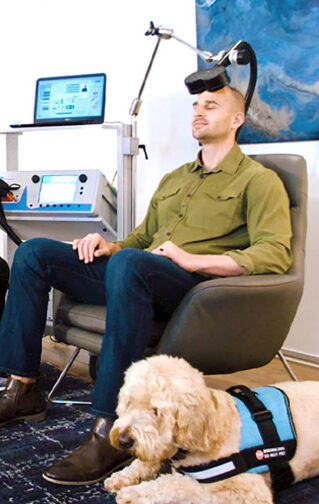
Each day, you will sit in a comfortable chair while the neurotechnician administers treatment using a hand-held magnet near the scalp. We deliver the magnetic impulses for 6-8 seconds each minute, and you may feel a slight sensation during treatment. This feels like gentle taps on the head, and it’s not at all painful.
After two weeks of treatment, we will perform a new qEEG to note changes and make any modifications if needed. The doctor will also have regular follow-up meetings with you to monitor and manage your progress.
MeRT treatments usually run from 6 to 8 weeks. In some cases, however, we recommend additional treatment to get the best possible results. Each individual is unique, and protocols may vary.

Our Medical Director, Dr. Mina Paiman
Dr. Mina Paiman’s understanding of PTSD comes from lived experience, not just medical training. Her husband, a U.S. Army veteran, returned from serving in Afghanistan carrying the invisible wounds of combat alongside a traumatic brain injury — giving her a front-row seat to how PTSD affects not only the person who experiences it, but everyone who loves them.
That experience shaped the way Dr. Paiman practices medicine. She has seen firsthand how PTSD can disrupt sleep, mood, relationships, and daily life, and how isolating it can feel for both patients and the families supporting them. It’s part of what drives her commitment to MeRT treatment as an option for veterans and others living with PTSD, and it’s why she approaches every patient’s story with genuine empathy rather than clinical distance alone.
As Medical Director of Brain Treatment Center Glenview, Dr. Paiman combines her Family Medicine background with this personal understanding to guide PTSD patients through treatment — bringing both expertise and the reassurance of working with someone who has walked alongside this condition herself.
Patient Experiences with Depression Treatment
“It was absolutely terrifying not to know what was wrong with me or how to fix the problem. MeRT not only identified the deteriorated state of my brainwave activity, it restored its function.”
US Army Veteran
“Within four days of being treated, I was sleeping through the night. My anger had subsided significantly, and I was smiling and enjoying things again. I was able to focus and concentrate on information much more efficiently and easily and did not get lost in conversation as I had prior to coming to BTC. My chronic headaches had ceased, my balance was returning, and my ringing in my ears (tinnitus) had also ceased.”
Marine EOD Tech
“With being diagnosed with PTSD, depression, and anxiety by Veterans Affairs, a calm and welcoming environment is important. The treatment makes me sleep longer and deeper than before treatment. My ‘dark feelings’ fade away. I feel happy and calm.”
Sean K.
Talk With Us About PTSD Treatment
Choosing a treatment for PTSD is a big decision—especially if you’ve already tried other options. That’s why we offer a free, no-obligation conversation with our New Patient Coordinator.
She’ll take the time to listen, answer your questions, and explain what treatment could look like for you—so you can decide if the next step feels right.
Or fill in the form below, and we will contact you.


Insurance Coverage and Payment Options
We understand that cost and coverage are important considerations when exploring treatment.
Our team will provide the documentation you need to submit claims to your insurance provider for possible reimbursement. Coverage can vary based on your individual plan. Some patients have reported partial reimbursement for services such as EEG testing and clinical evaluations, while others have not. Medicare does not currently reimburse for this treatment.
To make care more accessible, we also offer flexible payment options.
CareCredit® Financing
CareCredit allows you to spread the cost of treatment over time with convenient monthly payments.
- Quick online application
- Flexible financing plans
- No impact on your credit score to check eligibility
We accept all major credit cards, and our New Patient Coordinator is happy to walk you through insurance questions, financing options, and next steps—so there are no surprises.